Visualizzazione post con etichetta Celts. Mostra tutti i post

venerdì 17 marzo 2023

17 Marzo - St Patrick's Day

San Patrizio...tra leggenda e realtà ci porta in un tempo lontano.
Sulla sua esistenza non ci sono dubbi, ma la storia non conosce con esattezza la data della  missione, i nomi dei governanti irlandesi che incontrò e dove il suo ministero aveva sede. Lasciò un suo resoconto, un diario che sostanzialmente è una confessione della sua fede.

Non ebbe un’infanzia felice: nato probabilmente in Scozia nel 387 da una nobile famiglia (il padre era originario di una importante famiglia romana), a sedici anni Patrizio fu rapito nei pressi di casa sua, nella parte occidentale  della Britannia e venduto come schiavo ad un pastore irlandese. Dopo sei anni di schiavitù riuscì a fuggire e tornare dai genitori di là dal mare. Recatosi in Gallia, san Germano d'Auxerre lo consacrò vescovo. 
Ma già durante la schiavitù aveva deciso di dedicarsi alla vita religiosa. 


Tra il 431 e 432, fu nominato vescovo e su sua stessa richiesta, fu invitato quale missionario sull’isola occidentale dove in gioventù era stato schiavo.
Iniziò così la sua opera di conversione della popolazione irlandese dal paganesimo al cristianesimo, così come volle Papa Celestino.

Molte però sono le leggende legate a quest’uomo: si racconta che il desiderio di tornare in quella terra derivava da un sogno fatto nel quale egli  sentiva la voce degli isolani che lo invocavano di portare loro il Vangelo. 


St Patrick Cathedral - Dublin
(fonte 
http://www.irlandaonline.com/)
Secondo alcune fonti il 17 marzo è il giorno in cui morì intorno al 461 d.C. ma una leggenda racconta che in questo giorno San Patrizio estrasse la “pietra fredda” dall’acqua e questo giorno segnava la fine dell’inverno e l’inizio della stagione di semina.

A lui si deve anche il fatto che sull'isola d'Irlanda non ci sarebbero serpenti perché li cacciò in mare nel 441 dopo 40 giorni e 40 notti trascorsi sul monte Croagh Padraig (al termine del quarantesimo giorno scagliò un campana su una pendice del monte, scacciando dall’isola tutti i serpenti).


Il Monte Croagh Patrick
(foto tratta dal sito  www.croagh-patrick.co)
Oggi il monte è considerato una meta sacra ed è visitato da molti pellegrini ogni anno. 
Anche il celeberrimo pozzo di San Patrizio, fu così chiamato perché si dice custodisse un pozzo senza fondo, da cui si aprivano le porte del Purgatorio. 

Il trifoglio divenne simbolo nazionale quando San Patrizio, prese le sue tre foglie per spiegare la Santa Trinità al popolo irlandese pre-cristiano. 
Di conseguenza vestirsi di verde il 17 marzo e il trifoglio stesso, sono diventati simbolo di questo giorno.


San Patrizio diede vita ad una forma di Cristianesimo celtico che per conservare le radici e le tradizioni storiche del popolo irlandese, favorì la combinazione di molti elementi cristiani e pagani.  Un esempio è la croce solare sulla croce latina divenuta croce celtica il simbolo di questa forma di Cristianesimo.


San Patrizio è festeggiato in molti paesi da diversi secoli. Jonathan Swift, l’autore dublinese de I viaggi di Gulliver nel suo Diario a Stella annotava che nel 1713 il Parlamento di Westminster era chiuso perché era St. Patrick’s Day e che Londra era talmente piena di decorazioni da pensare che tutto il mondo fosse irlandese!!...


Il Giorno di San Patrizio viene ormai festeggiato in quasi tutto il mondo anche da chi non ha discendenze propriamente irlandesi. Per celebrare occorre richiamarsi all'Irlanda e al verde colore simbolo dell'isola. Il trifoglio come elemento decorativo non può assolutamente mancare!

Buon St.Patrick's Day !!:)


Visita il sito web della bellissima Cattedrale di San Patrizio a Dublino!

giovedì 21 settembre 2017

Mabon


Mabon is the second of three harves festival: Lughnasadh, Mabon and Samhain.  Mabon celebrates the second harvest and the start of winter preparations, and it is the time to respect the impending dark while giving thanks to the sunlight.
Because this holiday is determined by the movement of the Earth in relation to the Sun, the exact date and times varies from year to year; it is usually either September 22 or 23. On the equinox, night and day are nearly exactly the same length – 12 hours – all over the world. This is the reason it's called an "equinox," derived from Latin, meaning "equal night."
In the Northern Hemisphere  the September equinox is the autumnal (fall) equinox and in the Southern Hemisphere, it is the vernal (spring) equinox. 
In the past I have already written about this holiday because it really fascinates me so much. It's full of myths and legends! Here are my older post about Mabon


Mabon è il secondo dei tre festival del raccolto: Lughnasadh, Mabon e Samhain. Mabon celebra la seconda raccolta dei frutti della terra e l'inizio dei preparativi per il lungo inverno, nel rispetto dell'oscurità che si avvicina, rendendo grazie alla luce del sole.
Poiché questa festa è determinata dal movimento della Terra in relazione al Sole, la data e l'ora esatta variano da anno in anno; è di solito il 22 o il 23 settembre. Nell'equinozio, la notte e la giornata sono quasi esattamente la stessa lunghezza - 12 ore - in tutto il mondo. Questo è il motivo per cui si chiama "equinozio", derivato dal latino, che significa "notte uguale".
Nell'emisfero settentrionale l'equinozio di settembre è l'equinozio autunnale e nell'emisfero meridionale, è l'equinozio primaverile.
In passato ho già scritto di questa festività perchè mi affascina davvero tanto. E' piena di tradizioni miti e leggende! Qui i miei post precedenti.


martedì 31 gennaio 2017

Imbolc

by Warwick Goble
Morgana guardò la statua di Brigida e sentì il potere che se ne irradiava. Ma Brigida non è una santa cristiana, anche se Patrizio lo crede. È la Dea così come viene chiamata in Irlanda. E io lo so: queste donne riconoscono il potere dell'Immortale. Anche se esule, Lei prevarrà. La Dea non abbandonerà mai gli uomini.
(tratto dal libro "Le nebbie di Avalon" di Marion Zimmer Bradley)


Siamo nel pieno giro della Ruota dell'anno. Celebriamo il risveglio della natura con Imbolc la festività celtica che si festeggia il 1 febbraio. Lentamente le ore di luce del giorno si stanno allungando e pian piano dal freddo inverno si passerà alla mite primavera.
Imbolc è come tutte le feste celtiche piena di significati, di leggende e rituali. Il confine con la Candelora cristiana è molto sottile.  E' una festa di purificazione con un chiaro riferimento al risveglio della Natura nel grembo della Madre Terra. 

The Wheel of the Year is an annual cycle of seasonal festivals. We celebrate on 1 february the awakening of nature with a Celtic feast in honor of the return of light. Slowly the days get longer and slowly from the cold winter will move to the mild spring.
Imbolc is like all Celtic festivals full of meanings, legends and rituals. The line with the Christian Candlemas is very fine. It is a festival of purification with a clear reference to the awakening of nature in the womb of Mother Earth. 

sabato 30 gennaio 2016

Imbolc, the festival of light!


I often write about celtic use and customs!. I love the perfect relation with nature in a wheel of the year in which months, seasons, equinox and solstices are perfectly combined with human cycle of life. Nature and its elements became the essence of  everything and allows us to understand many of human behaviours.

Nei miei precedenti post ho spesso scritto di usanze e tradizioni celtiche. Mi interessa l' armonia con la natura, la una ‘ruota dell'anno’ in cui mesi, stagioni, equinozi e solstizi si combinano perfettamente con il ciclo della vita umana. Credo che con i Celti, più che in qualunque altra civiltà, la natura e i suoi elementi diventano l'essenza di tutto e i fatti accadono secondo un ritmo naturale che scandisce la vita e i comportamenti umani.

I Celti, Vita quotidiana, Neil Grant, San Paolo Edizioni

The “Wheel Of the Year “ is a cycle of festivals celebrate throughout the year in a seasonal path were cycles are of crucial importance for the survival of the species as the represent life, death ad rebirth of the Goddess and the God in their various incarnations.
Earth can’t fail her circular journey thought death to renewal as the sun can’t fail to return and bring back light and warmth!

La "Ruota dell'Anno" è più di un calendario liturgico pagano.  Le festività sono celebrate in un percorso stagionale in cui il ciclo è di importanza cruciale per la sopravvivenza della specie, per rappresentare la vita, la morte e la rinascita della dea e del dio nella loro diverse incarnazioni.
La Terra non può fallire nel suo viaggio attraverso la morte e la rinascita come il sole non può non tornare e riportare luce e calore!

I Celti, Vita quotidiana, Neil Grant, San Paolo Edizioni

Mother Nature is symbolized with her feminine aspect and earth is a natural mother, the Goddess,  who cares for her all creatures in a long journey from seeding to germination, from blossoming to fruit, from decay to rest. Ancient image of the great Mother Goddess dates back to Stone age.  They were fertile images that emphasizing hips, buttocks, thighs and breasts. She was Mother nature and through the cycle of seasons her body, changed from a maiden, mother and crone. 

Madre Natura è rappresentata con il suo aspetto femminile e la terra è come una madre naturale, la Dea, che si prende cura di tutte le sue creature in un lungo viaggio dalla semina alla germinazione, dal fiore al frutto, dal declino alla morte. Le antiche immagini della Dea Madre risalgono all'età della pietra. Esse  enfatizzano fianchi, glutei, cosce e seni. Ella, in qualità di Madre Natura, attraversa il ciclo delle stagioni e il  suo corpo, passa da quello di una fanciulla, a quello di madre anziana.

I Celti, Vita quotidiana, Neil Grant, San Paolo Edizioni
The maiden emerges now, at February with Imbolc festival, as the earth gently awakens in the spring and prepares to seed and to germinate.
Imolc is a festival of hope and renewal after the darkest time of the year with a growing light. It is a promise of fertility,, new life, and new hope.

La fanciulla emerge ora a febbraio con Imbolc, la celebrazione del delicato risveglio primaverile della terra che si prepara alla semina e germinazione.
Siamo al termine del periodo più buio dell'anno, la luce è crescente ed Imbolc è un festival di speranza e di rinnovamento,  una promessa di fecondità, nuova vita, e nuovi desideri.

I Celti, Vita quotidiana, Neil Grant, San Paolo Edizioni

Feast of the Bride, feast of the maiden.
Melodious Bride of the fair palms.
Thou Bride fair charming,
Pleasant to me the breath of thy mouth,
When I would go among strangers
'Thou thyself wert the hearer of my tale.
(From  Alexander Carmichael's collection of folk poetry).


sabato 12 settembre 2015

Celtic Harvest customs

Henry Parker - Harvesting
For the rural Celts harvest was the most critical time of the year and in September the corn harvest finished. The successful completion was cause for great celebration because it symbolize that families had more opportunities to overcome the long and cold winter. 

Per gli antichi Celti il tempo del raccolto era il momento più critico dell'anno. Nel mese di mese di settembre la raccolta del grano finiva e la positiva conclusione era motivo di grande festa, perché rappresentava per le genti l'opportunità di poter sopravvivere e superare  il lungo e freddo  inverno.

Henry Parker - Harvest Time, Lambourne, Berks

Leon Augustin Lhermitte
On September 21,  Mabon, the second of the great harvest festivals, was a time of rest and a chance to give thanks for the earth’s generosity. The great God returns to the Underworld, wheather in form of the Corn King who has been cut down and who fertilizer the earth with his seeds or as the dying sun who swallowed in the encroaching darkness.


Il 21 settembre era la seconda delle grandi feste del raccolto denominata Mabon. Rappresentava un tempo di riposo dopo il lavoro dei campi e la possibilità di rendere grazie alla terra per la sua generosità. Il grande Dio ritorna agli Inferi, sia in forma del Re del Grano che tagliato fertilizza la terra con i suoi semi o come il sole morente che viene ingoiato nell'oscurità.


There were many superstitions and protective practices that accompanied the cutting of the last corn. 
The last sheaf would be cut by a young girl, or the oldest reaper, or the reaper whose sickle, when thrown, cut the last stalks. After plaiting and decorating the last sheaf it was taken in procession to the farmer’s house and hung up where the harvest supper was to be served. Gorse was cut for fuel for ovens and bracken was cut to make bedding. The whitebait season began for fishermen.

L'ultimo raccolto era accompagnato da leggende e superstizioni. 
Il taglio dell'ultimo covone doveva essere fatto da una giovane ragazza o dal mietitore più anziano o da quello la cui falce aveva l'ultimo grano. Dopo aver intrecciato e decorato l'ultimo covone veniva portato in processione nella casa del contadino e appeso dove la cena veniva servita. Venivano tagliate le ginestre per essere poi utilizzate nei focolari. La stagione segnava anche l'inizio della pesca di piccoli pesci bianchi.


The-reapers by Helen Allingham
According to the Celtic tree calendar, September is the (Grape) Vine Moon associated with fertility, wisdom, creativity, inspiration and joy. The Vine is a symbol of both happiness and wrath with passionate emotions. 

Secondo il calendario celtico, Settembre è de nominato Vine Moon ed è associato alla fertilità, saggezza, creatività, ispirazione e gioia. 

by Frederick_Morgan
The season is also associated with apple harvest and is a celebration of grapes and viniculture. The buckwheat, cider apple, potato and seaweed harvesting was this month (hazelnuts were picked early in the month and the blackberries and late crab apple are prepared for roasting or making to preserve). September was also the month of White Straw.

La stagione è il tempo della raccolta delle mele e della celebrazione dell'uva e del vino. Altre attività legate a questo periodo erano la raccolta del grano saraceno, la preparazione del sidro di mele, la raccolta delle nocciole, delle more e la preparazione per la conservazione dei frutti durante l'inverno.  

by William Stephen Coleman

“All-cheering Plenty, with her flowing horn,
Led yellow Autumn, wreath'd with nodding corn."
Robert Burns, Complete Poems and Songs of Robert Burns


mercoledì 30 aprile 2014

Beltane & the Maypole


Beltane is the most important celebration of the Celtic calendar. Beltane means ‘fires of Bel’ (Bel was a Celtic deity). It is a fire festival that celebrates the beginning of summer.

Beltane è la più importante ricorrenza del calendario celtico. La parola Beltane significa 'fuoco lucente' e fa riferimento ai falò accesi per il Bel, dio della luce, del fuoco e edella guarigione. E' la festa in onore dell'estate che ritorna con i suoi frutti.

.

The Maypole is one of the main symbols of Beltane. Since ancient times, the young girls used to dance around the pole on which were attached colorful ribbons red and white symbolizing the red and white of the God and the Mother. The men held the red ribbon and the white women. During the dance ribbons were woven to form a symbolic crossing of birth around the pole phallic, which obviously represented the union of the Goddess and God.

L'Albero di Maggio è uno dei principali simboli di Beltane. Sin dai tempi antichi, le giovani fanciulle usavano ballare intorno al Palo su cui venivano attaccati nastri colorati rossi e bianchi  che simboleggiavano il rosso del Dio e il bianco della Madre. Gli uomini tenevano il nastro rosso e le donne quello bianco. Durante la danza i nastri venivano intrecciati per formare un simbolico incrocio di nascita attorno al palo fallico, che ovviamente rappresentava l'unione della Dea e del Dio.

May Pole - A Time to Keep by Tasha Tudor - I want to frame the pages from her books
Tasha Tudor
The origin of MayPole dancing dates back to the Pagan times and it was was connected with both the Druids, Wiccans and the Romans.

Le origine del Palo di Maggio risalgono ai tempi pagani. Fu simbolo dei Druidi, dei Wicca dei Romani.

parade of colors

Young Ladies Dancing Around the Maypole
Kate Greenaway
The festival of Beltane marked the beginning of the summer season and was celebrated by lighting fires. Wiccans celebrated by dancing round a Maypole and choosing a May Queen. 

Per i Druidi la festa di Beltane segnava l'inizio della stagione estiva pastorale ed era celebrata con l'accesione dei fuochi. Nelle celebrazioni Wicca si festeggiava ballando intorno all'albero e il rituale prevedeva la scelta della Regina di maggio.

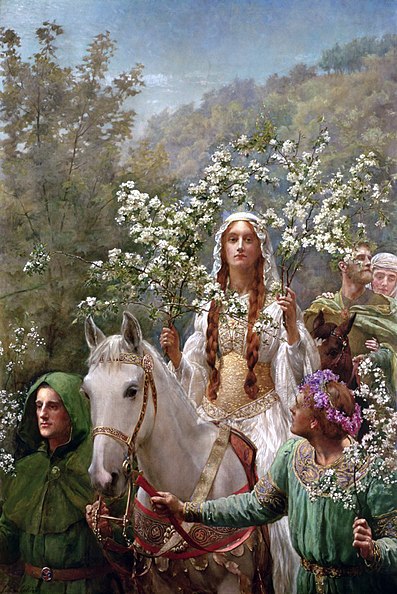
File:John Collier Queen Guinevre's Maying.jpg
Queen Guinevere's Maying, John Collier, 1900

The beginning of May was also an important celebration for Romans. They were devoted primarily to Flora, the goddess of flowers. The traditions and rituals of the Floralia were added to those of the Beltane culminating in May Pole dancing, which is still carried out to this day. 

L'inizio di maggio era un'importante celebrazione anche per i Romani dediti al culto di Flora, la dea dei fiori. Nel corso del tempo le tradizioni e riti della Floralia sono stati aggiunti a quelli di Beltane che avevano il culmine proprio con le danze intorno al palo.

Kate Greenaway - May Day
Kate Greenaway

The Maypole was basically a phallic symbol and MayPole dancing was strongly associated with fertility. Tree  has always been symbol of the great vitality and fertility of nature, and the descended ribbons were moved by the dancers in opposite directions. Sacred plant of this festival is the hawthorn. 

L'albero di maggio era dunque fondamentalmente un simbolo fallico e le danze intorno al Palo erano associate alla fertilità. Agli alberi, considerati simbolo della grande vitalità e la fertilità della natura, venivano appesi nastri colorati che i ballerini muovevano in direzioni opposte. La pianta sacra di questo festa è il biancospino la cui fioritura è proprio di questo periodo.

Young women with flower garlands - Kate Greenaway's Almanack for 1897
Kate Greenaway

kate greenaway
Kate Greenaway

May Pole!

sabato 15 marzo 2014

A journey through art, poetry, music and...legend!

Once upon a time... a great poet, some great painters, fantastic verses, wonderful singer, a relaxing music and .... a romatic legend ... and...they  gave us great emotion...!!

Provate a mettere insieme un grande poeta, dei grandi pittori, dei fantastici versi, una meravigliosa cantante , una musica rilassante e una leggenda da sogno...miscelare tutto e godersi dieci minuti di emozioni ! Che ve pare?:)
Alfred Tennyson, Helen Allingham
The poet
Lord Alfred Tennyson  (6 August 1809 – 6 October 1892) was one of the most important figure in Victorian poetry. He was born in Somersby, Lincolnshire. He studied at Trinity College, where he met Arthur Hallman, who was to  inspire much of his poetry.
Much of his verse was based on classical mythological themes. One of the most famous works are the Idylls of the King  (1885), a collection of poems based entirely on King Arthur and the Breton cycle, inspired from the stories written by Sir Thomas Malory about the legendary king.
The work was dedicated to Prince Albert, husband of Queen Victoria. With queen's patronage, Tennyson was acclaimed in 1850 as the greatest poet of his day and was appointed Poet Laureate of England, succeeding William Wordsworth ( the Poet Laureate was a very ancient tradition, dating back to the first days of classical civilization, to associate laurel with proficiency in arts and poetry). As a  poet laureate he became poet with task of composing poems at official events or characters of commemorative works of government. He held this position until his death forty-two years later; it was the longest term for a Poet Laureate of England in history.
In the course of his career, Lord Tennyson also worked in the composition of theatrical dramas He died in 1892 and was buried at Westminster Abbey. A memorial can be found in the chapel of Trinity College, Cambridge.

Il poeta
Lord Alfred Tennyson (6 Agosto 1809 - 6 Ottobre 1892) è stato uno dei più grandi autori della poesia vittoriana. Nacque a Somersby nel Lincolnshire. Studiò al Trinity College ove conobbe Arthur Hallman suo grande amico fonte di ispirazione per la sua poesia che si spense tragicamente prima del matrimonio con la sorella di Tennyson.
La poesia di Tennyson trattava principalemente de temi mitologici classici. La sua opera più famosa è  gli Idilli del re ( 1885), una raccolta di poesie interamente basata sulle leggende di Re Artù e del ciclo bretone , ispirata dai racconti scritti da Sir Thomas Malory sul leggendario re.
L'opera fu dedicata al principe Alberto, marito della regina Vittoria grande estimatrice del poeta tanto da nominarlo alla morte di William Wordsworth Poeta laureato ovvero colui che grazie alla stima goduta nei suoi confronti dai sovrani poteva comporre versi per la corona nelle grandi occasioni e negli eventi ufficiali ( il Poeta laureato è una tradizione ancora oggi presente che risale ai primi giorni della civiltà classica.).
Nel corso della sua carriera, Lord Tennyson compose anche drammi teatrali. Morì nel 1892 e fu sepolto a Westminster Abbey. Un suo memoriale si trova nella cappella del Trinity College di Cambridge.

William Holman-Hunt and Edward Robert  Hughes, The Lady of Shalott, 1905

The poem
 "The Lady of Shalott" is a Victorian ballad.  Tennyson wrote two versions of the poem, one published in 1833, of twenty stanzas, the other in 1842 of nineteen stanzas.

Il poema
La "Signora di Shalott" è una ballata in stile vittoriano.  Tennyson scrisse due versioni del poema, quella pubblicata nel 1833, di venti strofe, l'altra nel 1842 di diciannove strofe.

"I am half-sick of shadows, said the lady of Shalott"
John William Waterhouse
The legend
"The Lady of Shalott" was based on the Arthurian legend of Elaine of Astolat, one of the most fascinating legends of the entire Arthurian Romances. The lady lives in a tower on the island of Shalott, on a river which flows down from King Arthur's castle.
Due to a curse, however, she couldn’t look to Camelot, or she will die instantly. Not daring to look upon reality, she is allowed to see the outside world only through its reflection in a mirror weaving what she saw on a magical canvas. One day she glimpses the reflected image of the handsome knight Lancelot, and cannot resist looking at him directly. The mirror cracks from side to side, and she feels the curse come upon her. The punishment that follows results in her drifting in her boat downstream to Camelot 'singing her last song', but dying before she reaches there.

La leggenda
"La Signora di Shalott" è basata su una delle più affascinanti leggende arturiane: quella di Elaine di Astolat la dama costretta a vivere in una torre sull'isola di Shalott, in un fiume vicino a Camelot il leggendario regno di Re Artù. Una maledizione le impedisce di poter guardare verso la terraferma pena la sua stessa morte. Alla bella dama non resta che osservare il mondo esterno attraverso uno specchio tessendo quel che vede su una tela magica.
Ma un giorno, proprio attraverso quello specchio vede la figura di Lancillotto e stanca della vita vissuta fino a quel momento, guarda fuori verso l’uomo di cui si è innamorata all'istante. Ma sa che ormai la maledizione la colpirà; sale sulla barca e si lascia portare dalla corrente fino a Camelot, dove però arriverà morta.

John William Waterhouse, The Lady of Shalott

The song
The wonderful poems written by Tennyson were set to music and sung by Loreena Mackennit in her album The Visit (1991). Loreena is recognized worldwide as an icon of Celtic music.

La canzone
Musicato dalla cantautrice canadese Loreena McKennitt, contenuta nel suo album The Visit (1991). Loreena è riconosciuta in tutto il  mondo come un'icona della musica celtica.


On either side the river lie
Long fields of barley and of rye,
That clothe the wold and meet the sky;
And thro' the field the road runs by
To many-tower'd Camelot;
And up and down the people go,
Gazing where the lilies blow
Round an island there below,
The island of Shalott.
(…)

Lungo entrambe le rive del fiume si stendono
vasti campi di orzo e segale
che rivestono la brughiera fino a incontrare il cielo;
e attraverso i campi corre la strada 
verso la turrita Camelot;
e la gente va e viene,
guardando dove i gigli sbocciano
attorno all’isola, lì sotto, 
l’Isola di Shalott.
(…)


A bow-shot from her bower-eaves,
He rode between the barley-sheaves,
The sun came dazzling thro' the leaves,
And flamed upon the brazen greaves
Of bold Sir Lancelot.
A red-cross knight for ever kneel'd
To a lady in his shield,
That sparkled on the yellow field,
Beside remote Shalott.
(…)


A un tiro d’arco dal cornicione della sua dimora,
lui cavalcò fra i mannelli d’orzo.
Il sole giunse abbagliante fra le foglie,
e splendente sui gambali di ottone
del coraggioso Sir Lancelot.
Un cavaliere con la croce rossa perpetuamente inginocchiato
ad una dama nel suo scudo,
che scintillò sul campo giallo,
presso la remota Shalott.
(…)


She left the web, she left the loom,
She made three paces thro' the room,
She saw the water-lily bloom,
She saw the helmet and the plume,
She look'd down to Camelot.
Out flew the web and floated wide;
The mirror crack'd from side to side;
"The curse is come upon me," cried
The Lady of Shalott
(…)


Lasciò la tela, lasciò il telaio,
fece tre passi nella stanza,
vide le ninfee in fiore,
vide l’elmo ed il pennacchio,
e guardò verso Camelot.
La tela volò via fluttuando spiegata;
lo specchio si spezzò da cima a fondo
«La maledizione mi ha colta» urlò
la Signora di Shalott.
(…)


In the stormy east-wind straining,
The pale yellow woods were waning,
The broad stream in his banks complaining,
Heavily the low sky raining
Over tower'd Camelot;
Down she came and found a boat
Beneath a willow left afloat,
And round about the prow she wrote
The Lady of Shalott
(…)


Nel tempestoso vento dell’est che sferzava,
i boschi giallo pallido si indebolivano
l’ampio fiume nei suoi argini si lamentava.
Dal cielo basso la pioggia scrosciava 
sopra la turrita Camelot;
lei discese e trovò una barca
galleggiante presso un salice,
e intorno alla prua scrisse
la Signora di Shalott.
(…)


Who is this? and what is here?
And in the lighted palace near
Died the sound of royal cheer;
And they cross'd themselves for fear,
All the knights at Camelot:
But Lancelot mused a little space;
He said, "She has a lovely face;
God in his mercy lend her grace.
The Lady of Shalott.
(…)


Chi è? Che c’è qui? 
Nel vicino palazzo illuminato
si spensero i regali applausi
e, per la paura, si segnarono
tutti i cavalieri di Camelot.
Ma Lancillotto rifletté per un po’ 
E disse «Ha un bel viso;
Dio nella sua misericordia le conceda la pace
la Signora di Shalott».
(…)

Arthur Hughes, “The Lady of Shalott” (1873)