sabato 21 marzo 2015

World Poetry Day - 21 March

One ought, every day at least, to hear a little song, 
read a good poem, see a fine picture, and, 
if it were possible, to speak a few reasonable words.” 
Johann Wolfgang von Goethe, Wilhelm Meister's Apprenticeship

The World Poetry Day is a time to appreciate and support poets and poetry around the world. It is held on March 21 each year and is an initiative of the United Nations. Educational, Scientific, and Cultural Organization (UNESCO). The organization recognized the important role of poetry in the arts and in cultures throughout the world and over time.

I wish to share with you few verses from The Sensitive Plant, a poem composed in Italy by Percy Bysshe Shelley and published in Prometheus Unbound and Other Poems in 1820. The poem describes a garden of flowers tended by an unnamed Lady.

"The country diary of an Edwardian Lady", Edith Holden

Si dovrebbe, almeno ogni giorno, ascoltare una piccola canzone,
leggere una bella poesia, vedere un bel quadro, e,
se possibile, dire qualche parola ragionevole. "
Johann Wolfgang von Goethe, Wilhelm Meister's Apprenticeship

La Giornata Mondiale della Poesia è un momento per apprezzare e sostenere i poeti e la poesia in tutto il mondo. Si tiene il 21 marzo di ogni anno come riconoscimento dell'importanza del ruolo della poesia nelle arti e nelle culture di tutto il mondo e nel tempo ed è una iniziativa dell'UNESCO, l'organizzazione delle Nazioni Unite che si occupa di Educazione, Scienza e Cultura. 

Per condividere con voi questa celebrazione in questo giorno di primavera, vi riporto alcuni versi che nel 1820 Percy Bysshe Shelley, durante il suo soggiorno a Pisa pubblicò nella raccolta Prometheus Unbound and Other Poems. La poesia, dal titolo The Sensitive Plant, descrive un giardino di fiori curato da una signora senza nome.

E la primavera appare nel bel giardino, 
Simile al sentimento d'amore ovunque sentito;
E ogni fiore ed erba sull'oscuro petto della terra.
Si svegliò dai sogni del suo riposo invernale.
(...)
Il bucaneve e poi la viola
Si levarono dal suolo umido di tiepida pioggia 
E il loro respiro si confondeva col dolce odore
Che emanava dalle zolle come la voce con lo strumento
(...)
The Sensitive Plant, Percy Bysshe Shelley


venerdì 20 marzo 2015

Ostara and the Spring Equinox


Ostara also known as Easter, Alban Eiler , Lady day, is a Pagan holiday celebrated every year on the spring equinox on March 21. Ostara celebrates the Spring Equinox when day and night balance and the sun crosses the celestial equator.  
The myth of the spring is connected to 'Eostre', a Saxon goddess of fertility, hence the name of Easter in the English language (Easter) and the German (Ostern). 
In ancient time priestesses celebrated a special ritual that included the lighting of a candle as a symbol of the flame of life. In the temples the candle remained lit until the next day. With the spread of Christianity, the feast of Ostara was assimilated by Easter, whose date of celebration falls at the first full moon after the spring equinox.
Ostara is a time of renewal, regeneration and resurretion as the Earth wakes from her long slumber. On this day, we celebrate the fertility of the Earth with eggs, chicks, lambs and rabbit. Eggs is a symbol of new life and fertility and reminds us of the circle of life.


Ostara (chiamata anche Eostre, Eastre oppure Eostar) è una festa è di origine germanica, e prende il nome da quello della dea Eostre, patrona della fertilità. E' uno degli otto sabbat pagani e si celebra il giorno dell'equinozio di primaveraLa festa di Ostara celebra la rigenerazione della natura e la rinascita della vita proprio come la primavera celebra il risveglio della natura. Nell'antichità, le sacerdotesse della dea, all'interno dei templi, celebravano il rito dell'accensione di un cero come simbolo della fiamma della vita (seguito poi anche dalla tradizione cristiana) che veniva spento solo all'alba del giorno seguente. 
Ostara è tempo di rinnovamento, rigenerazione e di resurrezione proprio come la terra si risveglia dopo il lungo sonno invernale. 
E' questo il tempo di decorare le uova, simbolo di fertilità, di riflettere su nuovi progetti, e di mettere in pratica buoni propositi!:)

domenica 8 marzo 2015

A light exists in spring


Emily Dickinson 
(1830–86).  
Complete Poems.  1924

A light exists in spring
  Not present on the year
At any other period.
  When March is scarcely here
  
A color stands abroad         
On solitary hills
That silence cannot overtake,
  But human nature feels.
  
It waits upon the lawn;
  It shows the furthest tree         
Upon the furthest slope we know;
  It almost speaks to me.
  
Then, as horizons step,
  Or noons report away,
Without the formula of sound,
  It passes, and we stay:
  
A quality of loss
  Affecting our content,
As trade had suddenly encroached
  Upon a sacrament

Calendario 1999, Demetra Edizioni

sabato 28 febbraio 2015

The Kalevala: the epic poem of Finland

Thus the wise and worthy singer
Sings not all his garnered wisdom;
Better leave unsung some sayings
Than to sing them out of season.
Kalevala, Epilogue, line 20


On February 28 in 1835 was published the first version of the Finnish national epic Kalevala. It has profoundly influenced artists as Tolkien, Sibelius and Longfellow. It is originated from an ancient collection of songs called 'runes' passed down orally from father to son. In 1828 Elias Lönnrot, a Finnish philologist, doctor and botanist, began to collect songs and title poem Kalevala which literally means "land of Kaleva", the mythical ancestor and patriarch of Finnish ancestry. 

Il 28 febbraio 1835 fu pubblicata la prima versione del Kalevala l’epopea nazionale finlandese. Il poema è composto da un’antichissima raccolta di canti detti ‘runi’ tramandata da padre in figlio. Nel 1828 Elias Lönnrot, un filologo, medico e botanico finlandese, iniziò a raccogliere i canti e diede al poema il titolo di Kalevala che significa letteralmente "Terra di Kaleva", il mitico progenitore e patriarca della stirpe finnica. 

Kalevala The Finnish national epic
by Elias Lönnrot. First edition, 1835.

Lönnrot began to collect folk poetry and songs in 1828, but the real work began in the early 1830s. His goal was to preserve traditional Finnish poetry that existed only in the oral tradition and began to disappear due to the growing popularity of European rhymed poetry. He published the first version of his compilation in 1835.
The first version of The Kalevala (called The new Kalevala) was published in 1835. The version most commonly known today was first published in 1849 and consists of 23,795 verses, divided into fifty songs.

Lönnrot iniziò a raccogliere I poemi nel 1828 ma il vero e proprio lavoro risale al 1830. La prima versione del Kalevala fu pubblicata nel 1835 ma quella più conosciuta oggi risale al 1849 e consiste in 23.795 versi divisa in 50 canti. L’obiettivo di  Lönnrot era quello di preservare e tramandare le antiche gesta degli eroi finlandesi che esitevano solo nella tradizione orale e che lentamente stavano scomparendo per far posto alla poetica in rime.  

Portrait of Finnish physician and philologist
Elias Lönnrot (1802-1884)
"The Kalevala spread over the centuries. In the dark winter evenings, people sit down on a bench and listened the stories of the heroes, creators of their world and culture. The story, in metric, was sung by the skald helped by the rhythm beat on a drum with the edge of birch and reindeer skin. The effect was hypnotic and able to play a trance. Albeit in a non-declared, the meeting carried within itself valences shamanic and esoteric content "(source it.wikipedia)

“Il Kalevala è nato e si è diffuso nei secoli. Nelle buie sere invernali, i convenuti si accomodano su una panca ed ascoltavano le gesta dei vari eroi, creatori del mondo e della cultura di quel popolo. Il racconto, in metrica, veniva cantato dallo scaldo aiutato dal ritmo battuto su un tamburo col bordo di betulla e la pelle di renna. L'effetto era ipnotico ed atto a riprodurre uno stato di trance. Seppur in maniera non dichiarata, l'incontro portava in sé valenze sciamaniche e contenuti esoterici” (fonte it.wikipedia)

Väinämöinen

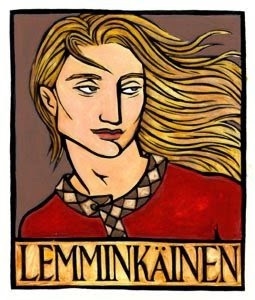
In the Kalevala we can read the stories of gods, wizards, witches and fairies with natural and supernatural elements. The three main heroes are Väinämöinen the old sage, poet and magician, Ilmarinen a skilled blacksmith who can forge the mythical Sampo, a magical object that produces wealth and joy for whosoever possesses and Lemminkäinen a cocky adventurer borealis, womanizer and brawler that during the poem is killed and then resurrected from the old mother.

Nel Kalevala si intrecciano le storie  di déi, maghi, streghe e fate e su uno sfondo di elementi naturali e soprannaturali I tre eroi principali sono Väinämöinen il vecchio saggio,cantore e mago,  Ilmarinen un abilissimo fabbro in grado di forgiare il mitico Sampo, un oggetto magico capace di produrre ricchezza e gioia per chiunque lo possieda e Lemminkäinen un presuntuoso avventuriero boreale, donnaiolo e attaccabrighe che nel corso del poema viene ucciso e poi resuscitato dalla vecchia madre.


Reading the Kelvala seems to enter the land of Finland. It 'a journey into nature, in the woods, in the forests and magical Finns nights.

Leggendo il Kelvala sembra di entrare nella terra finlandese. E’ un viaggio nella natura, nei boschi, nelle foreste e nelle magiche notti finniche.

The Aino Triptych, Akseli Gallen-Kallela (1865–1931)

The three pictures tell the story of Aino and VäinämöinenAino was Joukahainen's sister who was promised to the old and wise Väinämöinen in marriage after Joukahainen lost a magic singing match against Väinämöinen. Aino instead decides to drown herself.

Le tre immagini raccontano la storia di Aino e Väinämöinen. Aino era la sorella di Joukahainen che promise la giovane al vecchio e saggio Väinämöinen in matrimonio dopo aver perso con lui un match di canto magico. Aino decisa a non andare in sposa al vecchio, preferì annegarsi.

The right panel depicts mournful Aino weeping on the shore and listening to the call of the maids of Vellamo who are playing in the water. Aino has made her decision to choose death rather than her wizened suitor. The middle panel depicts the end of the story. Väinämöinen goes to fish for Aino in the lake that she entered. He catches a fish which he thinks to be a salmon and tries to cut her up with a knife, but the fish slips away from his hands and springs back into the water. Then the fish changes into Aino who proceeds to mock the old man, that he held her in his hand but couldn't keep her. After that she vanishes for ever.

Il pannello di destra rappresenta il triste pianto Aino sulla riva mentre ascolta il richiamo delle sirene di Vellamo che stanno giocando in acqua. Aino ha preso la sua decisione di scegliere la morte piuttosto che il suo corteggiatore avvizzito. Il pannello centrale rappresenta la fine della storia. Väinämöinen va a pescare nel lago in cui era entrata Aino. Prende un pesce che lui pensa di essere un salmone e cerca di tagliarlo con un coltello, ma il pesce scivola via dalle mani e ritorna di nuovo in acqua. E' Aino che deridere il vecchio e che scivola di nuovo nelle acque del lago per poi scomparire per sempre.

lunedì 23 febbraio 2015

Dedicated to one of my favourite poets...

John Keats 
(31 October 1795 – 23 February 1821

John Keats was an English Romantic poet and one of the main figures of the second generation of Romantic poets despite his work having been in publication for only four years before his death. His great love was Fanny Brawne Lindon and their engagement, lasting from December 1818 until Keats's death in February 1821, spanned some of the most poetically productive years of his life.
Bright star, the film's director Jane Champion released in 2010, tells the story of this unfortunate love that ended tragically with the death of the young man only 25 years old. Fanny kept all the letters that John wrote. Today is an important memorie of their love and the poetic of the young John.
Keats died in Rome on February 23, away from his Fanny, consumed by tuberculosis and assisted by his friend Severn.


Bright Star

Bright star, would I were stedfast as thou art
         Not in lone splendour hung aloft the night
And watching, with eternal lids apart,
         Like nature's patient, sleepless Eremite,
The moving waters at their priestlike task
         Of pure ablution round earth's human shores,
Or gazing on the new soft-fallen mask
         Of snow upon the mountains and the moors
No yet still stedfast, still unchangeable,
         Pillow'd upon my fair love's ripening breast,
To feel for ever its soft fall and swell,
         Awake for ever in a sweet unrest,
Still, still to hear her tender-taken breath,
And so live ever or else swoon to death.

'Brigh star' movie by Jane Champion
John Keats 
(31 Ottobre1795 – 23 Febbraio 1821
John Keats è stato un poeta protagonista della seconda generazione di poeti romantici, e oggi unanimemente è considerato uno dei più grandi poeti del Romanticismo inglese. Alcune delle sue opere hanno raggiunto la fama immortale che gli è stata negata quando egli era ancora in vita. Il grande amore per Fanny Brawne Lindon  ispirò la sua produzione letteraria migliore. 
Bright star, il film della regista Jane Champion uscito nel 2010, racconta la storia struggente di questo  grande amore che tragicamente finì con la scomparsa del giovane a soli 25 anni. Fanny conservò tutte le lettere che John le scrisse. Oggi sono un'importante traccia del loro amore e della grandezza poetica del giovane autore. 
Keats si spense nella casa romana di Piazza di Spagna, oggi museo, il 23 febbraio 1821 lontano dalla sua Fanny, consumato dalla tubercolosi ed assistito  dal suo amico Severn.

Fulgida stella

Fulgida stella, come tu lo sei
fermo foss'io, però non in solingo
splendore alto sospeso nella notte
con rimosse le palpebre in eterno
a sorvegliare come paziente
ed insonne Romito di natura
le mobili acque in loro puro ufficio
sacerdotale di lavacro intorno
ai lidi umani della terra, oppure
guardar la molle maschera di neve
quando appena coprì monti e pianure.
No, - eppure sempre fermo, sempre senza
mutamento sul vago seno in fiore
dell'amor mio, come guanciale; sempre
sentirne il su e giù soave d'onda, sempre
desto in un dolce eccitamento
a udire sempre sempre il suo respiro
attenuato, e così viver sempre,
- o se no, venir meno nella morte.